
Charlie Kost
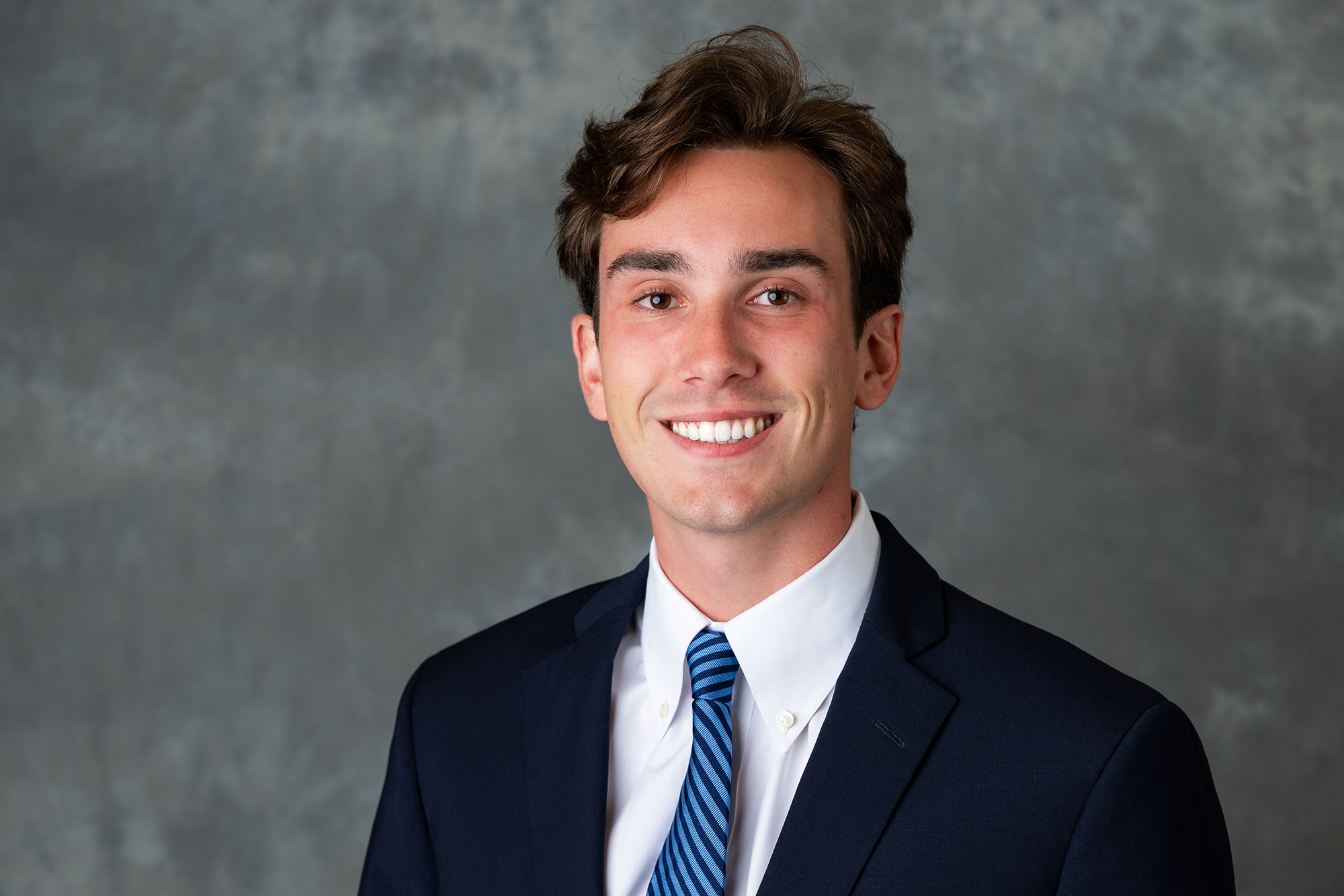
Charlie Kost
Major: Politics and International Affairs, French Studies
Minor: Linguistics
Hometown: Nashville, NC
“Wake Forest invites students not just to participate, but to contribute in ways both big and small.”
Most meaningful non-academic experience
The most meaningful non-academic aspect of my Wake Forest experience has been the opportunity to build deep, lasting friendships while getting involved in communities that care deeply about the life of the campus. What I came to appreciate early on is how much Wake Forest invites students not just to participate, but to contribute in ways both big and small.
I feel grateful to have been involved in communities such as the Traditions Council, Phi Alpha Delta, RUF, and Ambassadors in Admissions, where, over time, I was entrusted with increasing responsibility. In each of these spaces, I had the opportunity to learn from those around me, contribute to something greater than myself, and, in turn, support and create opportunities for younger students in the same way others had once done for me.
I also had the opportunity to serve on several university advisory groups, including the Campus Life Advisory Council, the Dean’s Student Advisory Panel, the President’s Aides, and the Provost’s Student Leadership Advisory Council. In these spaces, I was grateful simply to have a seat at the table and to contribute, even in small ways, to conversations about the student experience.
More than any title or role, what made these experiences meaningful were the people and the amazing Wake Forest community. The friendships formed through shared work, late-night conversations, and everyday moments have been the most lasting part of my time here, and I carry them with me with a deep sense of gratitude.
Favorite course outside your major
Two classes that were my favorite outside of my major were ART 235: Arts of London and FRH 353: Studies in French Art. Being able to experience great works of art while abroad, often in the very cities where they were created and displayed, transformed the way I engage with visual culture. Rather than encountering art solely through slides or textbooks, I was able to stand in front of these works and consider their historical, cultural, and spatial contexts in a much more immediate and impactful way.
These courses allowed me to see that art does not exist in isolation or for its own sake, but rather serves as a powerful medium through which other disciplines can be expressed. In particular, they expanded my appreciation for modern and contemporary art, pushing me to engage with forms and ideas that initially felt unfamiliar and, at times, challenging. Together, these two art experiences broadened my intellectual horizons and reinforced the value of interdisciplinary thinking, which has become a defining feature of my academic experience at Wake Forest.
Favorite Wake Forest tradition
Arnold Palmer Day! It’s such a great campus tradition that brings the community together to celebrate the life and legacy of a true Wake Forest legend while enjoying some AriZona Arnold Palmer.
Most influential person(s) in your journey
It is difficult to attribute my growth at Wake Forest to any single individual, as my time here has been shaped by a broad and deeply supportive community. Across both my academic work and extracurricular involvement, I have benefited immensely from the mentorship, encouragement, and investment of many faculty and staff members. If it had not been for taking an Introduction to Linguistics class with Professor Bender my freshman fall I probably would not be a linguistics minor and been interested in questions of language, culture, and power.
That said, certain individuals played especially formative roles at pivotal moments. Taking LIN 150: Introduction to Linguistics with Professor Bender during my first semester fundamentally reshaped my academic trajectory; it sparked my interest in questions of language, culture, and power and ultimately led me to pursue a minor in linguistics.
I am also deeply grateful to the resident professors who shaped my study-abroad experiences. At the Worrell House in London, Professor Lischer fostered an environment of intellectual curiosity and community, while on the Dijon Program, Professors Tarte and Murphy encouraged both deep academic exploration and cultural immersion. These experiences not only enriched my studies but also helped me develop independence and a more global perspective.
Even now, in my final semester, I continue to build new relationships with professors and benefit from their insight and experience. That ongoing mentorship speaks to the kind of academic community Wake Forest fosters, one where growth is continuous, and relationships extend beyond any single moment or course.
Together, these mentors and many, many others have had a lasting impact on my Wake Forest experience, and I carry their influence with me as I look toward the next stage of my academic and professional journey.
Most rewarding student experience
One of the most rewarding experiences I had as a Wake Forest student was my time as a Richter Scholar in the summer of 2025. Under the mentorship of Dr. Margaret Bender, I conducted independent research in Paris on the language of judicial decision-making in French courts. Working in libraries such as the Bibliothèque Cujas and the BnF, I compiled a corpus of decisions from the Cour de cassation and the U.S. Supreme Court to analyze how legal traditions shape judicial language. Living independently in Paris while carrying out this project taught me that I really thrive when pursuing complex questions on my own. The experience gave me confidence in my ability to navigate new intellectual and cultural environments and strengthened my commitment to studying law, language, and culture.
What you’d tell your first-year self
Get involved and go to office hours. It seems very scary to put yourself out there (especially if you’re an introvert), but once you realize everyone is in the same boat and going through life for the first time, too, it can help unlock a world of opportunities. Another piece of advice I got from a senior when I was a first year was to never say no to a late-night Cook Out run; you never know what memories and friendships can come out of it.
Evolution of your career plans
When I first arrived at Wake Forest, I expected to go straight to law school after graduation. Over the past four years, however, my academic experiences, particularly taking an Introduction to Linguistics class to fill my schedule in the fall of my first year, have led me to develop a strong interest in linguistics, specifically in the relationship between language and the law. Through coursework and research projects, I realized that studying language more deeply would strengthen my long-term goals in law. As a result, I am now planning to pursue graduate study in applied linguistics in London before law school. This path allows me to further develop the interdisciplinary interests I discovered at Wake Forest while still preparing for a future legal and even academic career.