
Roksanna Keyvan
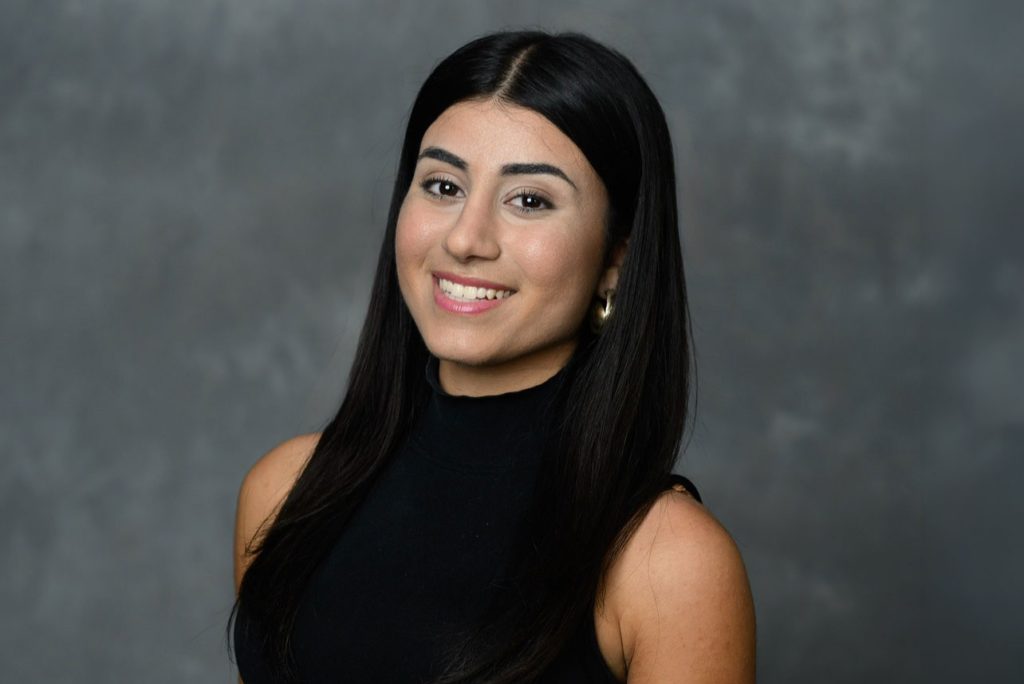
Roksanna Keyvan
Major: Environmental and Social Justice (Interdisciplinary Studies)
Minor: French Studies
Hometown: Coral Springs, Florida
“Wake Forest gave me the chance to test my values in practice, turning curiosity into responsibility and learning into contribution.”
Greatest change since your first year
The most fundamental change I’ve experienced since my first year is confidence. Wake Forest taught me to trust my abilities and take my passions seriously — to pursue opportunities even when they felt intimidating and to see challenge as evidence that something was worth trying.
Over time, confidence became practical rather than abstract. I learned to introduce myself to strangers and build meaningful networks, to stand firm in my beliefs, and to continue forward even when outcomes were uncertain. I began to understand that motivation does not guarantee success, but it consistently produces growth, connection, and unexpected opportunity.
What once felt risky now feels necessary: advocating for myself, engaging unfamiliar spaces, and believing in my potential before external validation arrives. That shift — from hesitation to self-trust — has been the most lasting transformation of my college experience.
Most meaningful non-academic experience
The most meaningful non-academic experience at Wake Forest has been the opportunity to live my interdisciplinary interests beyond the classroom. My education stopped being theoretical once I began applying it alongside communities, practitioners, and institutions around the world.
Halfway through my sophomore year, I was awarded the full-merit Stamps Scholarship, recognizing leadership, innovation, scholarship, and service. That support transformed what was possible. Through more than $24,000 in experiential funding (from Stamps and other campus sources), I was able to pursue research, professional work, and public engagement internationally.
In London, I presented my work on environmental justice and human rights to students, legal practitioners, and international delegates — including speaking engagements across legal institutions and youth forums. During summer 2025, I interned under a King’s Counsel human rights and counter-terrorism lawyer, where I served as Project Director for a nonprofit Girls Human Rights Hub. I led a small research team and helped design a multi-country accountability framework measuring national laws, policies, and implementation across 12 thematic areas to support evidence-based reform. This framework is now a landmark research tool that will be implemented and utilized by law firms across London and the world.
My work with the Girls Human Rights extended to collaboration with the United Nations. As Research Lead, I helped conduct a cross-country ethnographic survey spanning 10 nations and contributed to a formal submission to the Office of the High Commissioner for Human Rights on the Marshall Islands’ nuclear legacy. In Summer 2025, I also attended the UN Human Rights Council in Geneva as Youth Representative for the Girls Human Rights Hub, engaging in sessions on gender justice and equitable development, and authored a multidisciplinary study combining statistical and ethnographic data to support international policy recommendations.
At the same time, I worked with Professor Alessandra Von Burg as a Teaching Assistant to develop civic engagement and sustainability programming for undergraduate students. Our collaboration became a co-authored paper on Sustainability and Prosperity presented at the University of Florence and published by Firenze University Press.
What made these experiences meaningful wasn’t just travel or professional exposure; it was realizing that ideas formed on campus could have real consequences beyond it. Wake Forest gave me the chance to test my values in practice, turning curiosity into responsibility and learning into contribution.
Songs that define your Wake Forest experience
Several songs will always remind me of my time at Wake Forest because they became soundtracks to specific memories and friendships.
“Baile Inolvidable” represents my college experience best—an unforgettable dance shaped by an international community of friends who broadened my perspective. My friends know it’s my favorite, and they would play it whenever we gathered or even when I walked into a room. Over time it came to mark celebrations, late nights, and everyday moments, carrying me through much of my undergraduate life.
“Adventure of a Lifetime” by Coldplay has been a favorite since I was younger, but at Wake Forest it took on new meaning. The title itself mirrors how I now see these years: a rare, joyful chapter defined by growth, risk-taking, and discovery.
“Rollin’ brings back memories of traveling with friends — both on and off campus. Whenever I hear it, I can immediately picture specific drives, conversations, and laughter. It’s less about the song itself and more about how instantly it transports me to the people and places that shaped my happiest memories. I also always use it in my cycling classes as a motivating song for intense hill-based rides; whenever you hear it you know you have a lot to overcome, but the journey is always worth it.
Impact of Pro Humanitate
Pro Humanitate transformed my understanding of education and ambition. I first encountered it not as a phrase, but as an action — being recognized, encouraged, and welcomed before I had “earned” it. Throughout my time at Wake, it showed up in professors opening doors, alumni mentoring strangers, and peers cheering one another on. Moving forward, Pro Humanitate will guide how I approach leadership and career-building: Success is not about outrunning others, but about widening the path so more people can move forward together.
Favorite course outside your major
My favorite class outside my major was Art 298: Contemporary Art and Criticism. Although listed as a course, it functioned more like a student-run acquisition committee. We taught one another contemporary art practices and collectively determined which works our university would purchase. I participated as the only sophomore selected for the 2024 Reece Collection Acquisition Committee’s New York art-buying trip — one of just eight undergraduates entrusted with investing over $100,000 in contemporary artworks for the Mark H. Reece Collection of Student-Acquired Contemporary Art at Wake Forest University.
Over the semester, we evaluated more than 300 artists, weighing representation, material sustainability, and long-term educational value. Our discussions were guided by Audre Lorde’s belief that “there is no such thing as a single-issue struggle,” reminding us that artistic expression is inseparable from identity, politics, and community responsibility. Rather than simply choosing works we personally liked, we learned to justify decisions through collective reasoning and public accountability.
As an artist, I entered the class believing I understood what made art meaningful — its emotional resonance and communicative power. The course revealed a much broader ecosystem. I observed how curators, critics, galleries, and market forces shape artistic value, sometimes reinforcing creative vision and sometimes distorting it. After acquiring eight works in the spring, we spent the following fall designing public programming to explain our choices, translating acquisition into education through a multicultural, multi-modal exhibition.
This experience appealed to me because it transformed art from an individual practice into a civic one. It taught me that creating culture is not only about making objects, but also about stewardship, dialogue, and responsibility to a wider public — an understanding I will carry into every intellectual space I enter.
Favorite Wake Forest tradition
Wakeville is my favorite Wake Forest tradition because I’ve grown alongside it.
I first learned about Wakeville from friends who shared my passion for art. At the time it was a new interdisciplinary arts and culture festival, and I remember attending as a first-year student simply enjoying the experience. I was inspired enough to write about it for the Old Gold & Black, thinking I was just covering an event. The following year, those same friends invited me to join the leadership team as a marketing co-lead. For the first time, I saw the planning, logistics, and collaboration required to bring a creative community together.
By my junior year, I was invited by the Wake the Arts team to serve as co-director. With a team of volunteers, we reimagined Wakeville through a sustainability lens, expanding campus-wide collaborations and integrating environmental programming — including a participant-led ceremonial tree-planting. Now, in my senior year, I serve as Strategic Director and community liaison as we plan our most ambitious festival yet.
Over four years, Wakeville has evolved into a leading sustainability and arts festival. We secured $19,000 in funding across two years ($9K in 2024; $10K in 2025), expanded University and community partnerships, and welcomed more than 600 attendees in 2024 and 400 in 2025, with even greater goals ahead.
Wakeville is my favorite tradition because it reflects my own college journey: I arrived as a participant, grew into a collaborator, and now help steward something lasting for the community that shaped me.
Most surprising aspect of your experience
What surprised me most about my Wake Forest experience was how fully the University trusted me to shape my own intellectual path.
By the middle of my sophomore year, after changing my major twice and my minor five times, I realized I wasn’t indecisive; I was searching for a way to ask questions that didn’t belong to just one discipline. I proposed combining environmental studies, anthropology, politics and international affairs, and sociology into a single program focused on how institutions absorb shocks, distribute risk, and respond to socio-ecological disruption. Instead of being told it was too broad, I was met with encouragement and guidance. With the support of faculty and administrators, I created an interdisciplinary degree in Environmental and Social Justice that reflected how I actually think.
That trust opened doors I didn’t expect. I was allowed to take graduate-level courses in sustainability and law, work alongside undergraduates, graduate students, and professors, and pursue directed research at the intersection of health, environment, and governance. I wrote epidemiological case studies, analyzed policy failures, and eventually published research on humanitarian resilience and sustainability, presenting at Elon University and publishing through Dartmouth College. My co-produced work on Sustainability and Prosperity was presented and published in Florence by the University of Florence. My honors thesis, Human Security and Inherited Futures, included ethnographic-inspired research with Marshallese communities and examined how risk becomes embedded in social and institutional systems.
What surprised me wasn’t just the flexibility; it was the consistent answer of “yes.” Yes to crossing disciplines, yes to working across levels of study, and yes to intellectual curiosity that didn’t fit neatly into a box. Wake Forest didn’t just allow me to study broadly; it taught me that meaningful questions often live between fields, and that education can be designed to meet them there.
Evolution of your career plans
As a first-year student, I planned to pursue a law degree, the original inspiration behind my major. Over time, however, my goals shifted toward impact consulting, development strategy, and sustainable innovation, working at the intersection of social and environmental transformation.
Through my coursework and experiences, I realized I was most energized when working across disciplines rather than within a single specialization. I didn’t want to be confined to one professional lens; instead, I wanted a role that would allow me to connect sectors, translate ideas into action, and operate at multiple scales—from organizations to communities.
My career interests, therefore, became more business- and strategy-oriented, while still grounded in the same socio-ecological commitment that initially drew me to law. Rather than advocating for change solely through policy, I now hope to help design and implement solutions directly — bridging stakeholders and turning impact into practice.
These experiences motivate my ambition to become an interdisciplinary innovator working at the intersection of sustainable development, climate displacement, and the science–policy interface in socially vulnerable contexts. In the short term, I aim to join an internationally oriented impact consultancy, designing market-based and science-aligned strategies that address institutional barriers to sustainability. In the long term, I plan to establish my own consultancy focused on governance across the humanitarian–development nexus.